ilivetotravel's travel log

Exploring and Sharing the World!

On the Way to Tanzania, via Dubai

My first international travel with the non-profit organization I work for was Tanzania.  Originally intended as a one week review of operational controls, a second week was added to the trip to get me exposure to the field work we do in the developing world.  I jumped at the opportunity to see firsthand what my new organization did and looked forward to my first opportunity to see sub-Saharan Africa.

Again, getting there is half the fun

Being mindful of cost, I found what was an incredibly cheap fare from Atlanta to Dar es Salaam for less than $1500.  I did have to connect in Gatwick (connection hell, second perhaps to CDG) and then in Dubai.  Connecting in Gatwick became more hell than I expected when I was informed I could only continue with one carry-on after standing in a security line for connections that would make a tortoise race look speedy.  I had with me my laptop bag and a small backpack with camera and personal items.  Shocked at this absurd rule from a major international gateway (which I have proactively sought avoiding ever since and recommend likewise), I had to reconfigure things such that I could send via checked luggage my now fairly empty laptop bag.  Surely, as a passenger I could be notified of these sclerotic rules AHEAD of getting to the annoying airport?

In London I switched to Emirates Airlines and things picked up quickly.  What a fantastic airline.  Though traveling coach/tourist class, you are treated as if you had paid business class.  Some frills (like footrests) but, more than anything, it was the flight attendants’ attitude towards their customers.  I think U.S. based airlines have forgotten who it is they are seeking to serve.  You don’t have to spend money, just please treat me nice and pretend you are happy I am there.

The special surprise for me on this Dubai-bound flight (besides the footrest) were the cameras in the underbelly and nose of the aircraft.  You could watch from your seat monitor as you flew over things or the space straight ahead!   A little freaky at first, it quickly became fascinating.  Tops was watching the approach and landing in Dubai from the camera feeds.

Laying it over in Dubai

In Dubai, I had a very long 9 hrs. layover.  I had tried to book a room in the hotel in the secured zone of the airport but it had been full weeks in advance and I didn’t feel like leaving the airport.  Through research, I did find out that for like $12, you could take a shower in the gym facilities at the airport.  These shower facilities were very nice and spacious (you got a private room) and that shower was heavenly.  It helped me re-charge a little bit but 9 hrs. was too much time.  Since I was traveling alone, it was hard for me to lower my guard enough to nap in any of the sitting areas or areas with the seats made for napping (nice airport!).  So I was extremely fatigued and lucky to not have fallen asleep unexpectedly and deeply before my flight to Dar!    I slept like a baby on the flight to Dar and I do not fall asleep easily on airplanes…

img_1478The Dubai airport is very glitzy in a commercial/Las Vegas-ish kind of way.  But it felt nice and clean.  It was interesting to see the flights to all these, to me, very exotic destinations that one rarely hears off in the U.S.:  Khartoum, D’jamena, Tehran, Riyadh, etc.  Very cool.  Then you see the passengers from all over the world who cross paths at the airport with different languages, clothing, and customs…  People ARE people.   Seeing people sleeping UNDER the seats in the hallways of the concourse sure made it feel like the Dubai airport was the air-equivalent of a train station of the world, if such a thing existed.

The Dubai airport is also known for its shopping arcade.  I did compare prices on some things and they did not seem really cheaper than back home (for example, electronics).  That may have changed since I went a couple of years ago but it is best to do research before heading there to make sure you know if you are getting a deal…  It may be that the real deals are in things like jewelry but that was not an area I researched nor was looking to shop in.  Does anyone have any insights into what are the best deals to be had in that airport?  Any other suggestions for things to do in that airport or the ease of getting in and out of the airport for a hotel stay in between flights?

In future entries, I will share more about Dar, Mwanza, the Serengeti, and Zanzibar.  Stay tuned!

January 31st, 2009 Posted by | Africa, Tanzania | 8 comments

Southern Spain – The Jewels of Andalucía – Córdoba and Granada

In a land known for being enriched by the comings and goings of history, Córdoba and Granada stand out as the jewels of the mixed currents of history.

Córdoba

Of the two, Córdoba felt more a mixture of glorious history and modern livability. Granted, I did not explore both cities fully, so this is a high-level impression and I welcome comments sharing further perspectives on this.  The centerpiece of Córdoba, of course, is la Mezquita de Córdoba. Originally a church, converted to mosque, and returned to a church during la Reconquista (the expulsion of the Moors from Spain), it stands as a record of the currents it experienced.  Seeing the inside of the mosque (not sure why we call it a mosque to this day since it is officially a church now but we do) is to marvel at the artistic and architectural talents of the Moors.  It is also a credit to someone from the 13th century who, after the expulsion of the Moors, did not go back and undo all the construction done by them so, today, we can enjoy the beauty of the arches that grace the church.  (There was some retrofitting done to insert a church within the structure much as the Moors had done earlier when they converted the church to a mosque.)  Outside the structure, the orange tree garden is also a nice feature of the grounds.  To me, it is one of the most important architectural sites in Spain, or at least one that appeals to me for being a picture of the movements of history.

Granada

Granada definitely had a unique feeling as well.  Granada felt more regal.  From the cathedral as a final resting place of the Catholic Monarchs (“tanto monta, monta tanto, Isabel como Fernando“, for native Spanish speakers, remember that?) to the Alhambra and Generalife settings and gardens, everything about Granada makes me think of “royalty”.

But the most vivid memory for me is the night we arrived.  I was at the wheel and we were looking for our hotel in the city center.  This is before Internet days, etc. so we just had an address and a map.  I found a street that would deposit me on our hotel’s street.  However, as the street began to narrow, I wondered what I had gotten myself into.  Yes, the road continued narrowing as small beads of sweat began appearing on my forehead.  Of course, the climax of this was when we came to the narrowest point in the street.  The car would not go through.  Cars were beginning to accumulate behind me.  The motorcycle ahead of me stopped to look back at me.  Beads became torrents.  How would we get out of this bind??!!  Well, thank the Peugeot engineer who decided that model should have folding mirrors.  That was the margin of error in passing or not passing…  Drivers beware – choose cars with folding mirrors and wear a bandanna when driving in ancient city centers.

Back to the main features though… The Alhambra was a hilltop palace of the Moorish rulers of Spain.  The attention to detail in the carvings on the walls, ceilings, columns, etc. is spectacular.  Thinking of someone doing that detailed work blows my mind.  Some of the most famous sights from the Alhambra are the water fountains in the courtyards of the palace (e.g., the Courtyard of Lions).  The Generalife (pronounced “heh-neh-rah-LEE-feh“) gardens are constructed next to the Alhambra and also use water fountains.  The design of water flowing between fountains at different levels as you descend down the hillsides is enchanting.  To me, it is not that there are fountains but it is how they were able to show water in motion in a clever scheme to move water from fountain to fountain.

Finally, having grown up studying Spanish history and the discovery of the New World, seeing the tomb of the Catholic Monarchs was like closing the book on all those history classes.  There they were, their remains in metal caskets in the Royal Chapel, the most powerful people of their time.

Both of these towns have plenty more to offer than I explored or than I wrote about.  They are enchanting and should be tops on the list of anyone wanting to see and get to know Spain.

Would like to hear about your experiences in Córdoba and Granada and what you saw that impressed you the most about these two great examples of two cultures clashing or combining, as the case may be.

January 29th, 2009 Posted by | Europe, Spain | no comments

A Winter Visit to Helsinki

Many moons ago, I got to go to Helsinki for a 3-week work assignment.  I remember the conference call with Helsinki when they were asking if the U.S. practice could send someone over.  I knew I was the one who would be sent and I was trying not to show visible signs of excitement at the possibility of going to Finland, even if it was the middle of winter…

Is It Gray Everywhere?

I flew Swissair, when it still existed (fantastic service! what happened??), to Zurich and connected there to Helsinki.  Landing in Zurich in winter was an impressive sight.  The Alps were visible with the sun coming up behind them and a carpet of clouds covering the area around the peaks so that I gained a strong appreciation for the technology that permits flying without seeing fully where you are going.  After clearing the cloud cover, Zurich winter climate turned out to be less impressive being all gray.  Landing in Helsinki, we did not see the city until only moments before landing, for similar reasons.  Was it gray all over Europe that day?  I wondered…

Curiosities – Day 1

My company’s office was very modern and in the city center.  It occupied a few stories of a 5 story building with the top floor being the sauna (his and hers) but with a meeting room by the saunas and with the same wooden paneling as the sauna which made me believe they conducted meetings before going to the sauna.  I also noticed in the restroom a small hose next to the bathroom sink and close to the toilet.  A first for me… no, I didn’t try it :)

Eating in Helsinki

I ate my first reindeer (or a part of one) in Helsinki at a restaurant called Lappi.  It was delicious.  I have to admit that in my mind I was thinking how much I was going to enjoy telling my godchild I ate Rudolph…  I also did get to eat at a Mexican restaurant which felt more Finnish-Mex than Mexican.  But, I have to admit, I wanted to see what Finns were being sold as Mexican food.  I had thought I had figured out there was a very popular local chain called Ravintola because I saw it everywhere until I figured out that was Finnish for restaurant.  I felt dumb but since I was traveling alone, no one knew… I think working from the morning (can’t say the crack of dawn – it was Finland in the winter, remember?) until late in the evening did make me a little less bright, like their winter sky.

Sightseeing

Back when the USSR was, Helsinki was the backdrop for movies that wanted to pretend they were in Russia.  You can sense that when you see their churches.  One thing that struck me was how colorful buildings were.  Then I realized that since winters must be as gray as I was witnessing, the color of the buildings made a big difference.  The Lutheran Cathedral, while imposing on the outside, was rather blah inside.  However, that year they were building a small church made from ice in the plaza.  I understand they do this every few years and, while it was not finished so I couldn’t go inside, it was very peculiar and impressive.

Helsinki's Lutheran Cathedral and Ice Church

Credit: http://www.msnbc.msn.com/id/20149309/ns/travel-destination_travel/t/europes-wildest-weather-cities/

I also signed up for a half day city tour to make sure I saw anything deemed important (I didn’t have too many days off in those 3 weeks…).  It was via this tour that I saw the famous shipyards where they make the big cruise ships.  I also saw the monument to Sibelius which, surrounded by snow, look surreal and beautiful.

I could tell, even in winter, that the city must be beautiful in the summer.  Had the work sold, I would have spend two years there and I regret that did not happen as it would have been an interesting experience and I believe I would have loved being a resident of Helsinki.

January 28th, 2009 Posted by | Europe, Finland | one comment

Bella Bologna – Italy’s secret

The following is a guest post by fellow traveler, Chris Sanders.

A few years ago, as part of my graduate studies at The Johns Hopkins School of International Studies (SAIS), my wife Wendy and I had the wonderful opportunity to live for a year in Bologna – a provincial Italian town situated in the northern region of Emilia-Romagna, the region just to the north of Tuscany. Bologna and the broader region are an absolute treasure trove of culinary and other travel delights. It’s difficult to understand why such a wonderful part of Italy is today still relatively undiscovered by tourists (hence the name of this post “Italy’s secret”)…in Bologna and throughout Emilia-Romagna, you’ll find good eats and good sites and sounds, but you will not find hordes of tourists! Hey, maybe that’s what makes it so interesting to visit!

To whet your appetite, I’ve included a few notables about Bologna and the surrounding area…we highly recommend a visit!!

Bologna

It’s a shame the name of this town is the same as a cheap American lunch meat, because nothing could be farther from an appropriate comparison! Ok, there is a bologna like meat from Bologna called “mortadella” – but Bologna offers so much more than lunchmeat! For starters, how about Bolognese sauce (the yummy meat sauce we all love in our spaghetti) – it comes from Bologna! And then there is the wonderfully rich lasagna vert – a green spinach pasta lasagna made with ragu and béchamel sauce, oh man! Finally, Bologna is the birthplace of tortellini and the headquarters of Manjani Chocolate – makers of Fiat – umm, umm goodness! For all these culinary notables, Bologna is often referred to as “Bologna the Fat.” I wish I could recommend a good restaurant in Bologna, but ironically, we rarely ate out because Wendy took cooking lessons from an Italian Chef throughout the year and I was, quite happily, her test subject!

Aside from good food, Bologna is also known as a university town. The University of Bologna is old (founded in 1088), huge, and has several famous alumni including Dante, Thomas Becket, Erasmus, and Copernicus to name a few. My school, Johns Hopkins, also has a small campus in Bologna. Interestingly enough, the Johns Hopkins campus was constructed with CIA seed money following WWII and was initially envisioned to be a listening post of sorts during the Cold War (Bologna was controlled by the communist party until the 1990s).

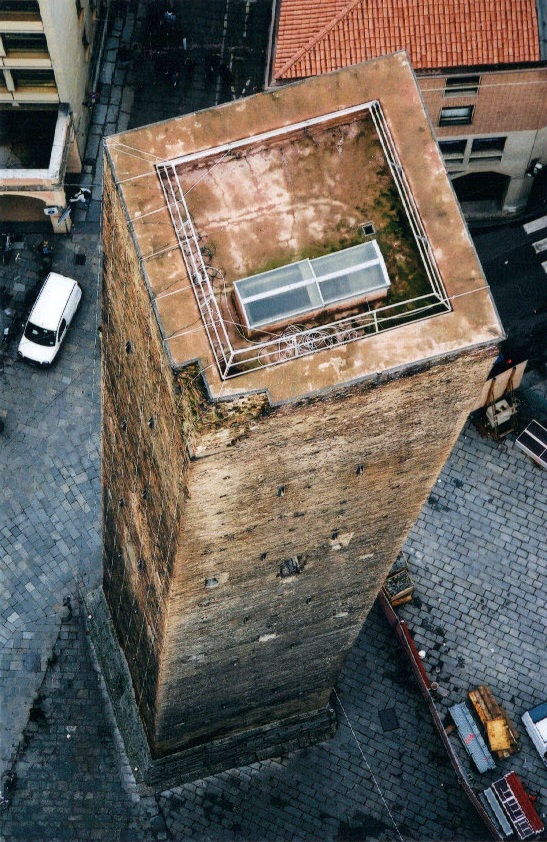
Other notable mentions about Bologna include: Great architecture – particularly porticos (some say it is possible to walk around the entire city and not get wet during a rain shower), plenty of old churches, it’s the burial place of St Dominic, it’s the headquarters for Ducati Motorcycles (on one visit to the factory, Wendy actually got to start one up on the assembly line), and it’s the headquarters for Furla – a fact Wendy cherished and still cherishes…there are more Furla shops per square km in Bologna than in anywhere else in the world…and my wife has been to them all!

Colli Bolognesi

If Bologna can be described as “off the beaten path” of typical visitors to Italy, the Colli Bolognesi is – I suppose- “off off the beaten path?” The Colli are the rolling hills that surround the city and this area is definitely worth a visit. Aside from the scenic beauty and quietness, the Colli Bolognesi is also home to a number of vineyards and bed and breakfast establishments. One that my wife and I came to know (and its our favorite in the region) is Corte d’Aibo (http://www.cortedaibo.it/eng/) . Corte d’Aibo makes a bold Cabernet and Merlot – my wife and I were surprised to find it on the menu at Mezzaluna in NYC (a favorite haunt of ours when we are in the Big Apple).

There are so many great things to experience in and around Bologna. Please share your experiences with this great Italian secret. Do you have a favorite experience, restaurant, or site? Do tell!

January 24th, 2009 Posted by | Europe, Italy | no comments

30 Days on El Camino de Santiago

Camino icon

Camino icon

Guest post by my friend and fellow traveler, Chris Sanders.

I first learned of the Camino de Santiago by watching an interview of Shirley MacClain on CNN’s Larry King show some years ago. I wasn’t even sure I knew who she was to be honest, but I listened with interest as she described a long distance hike – a pilgrimage – she had just completed across Spain – a hike she did alone but in the company of thousands of others on the same route. The experience sounded appealing to me and so I filed the idea away in my mind –to be resurrected sometime in the future…sometime when I had free time…lots of free time….like a month or so off of work!

Well, long story short – within a few months of watching the interview on CNN, I found myself in Spain on the Camino de Santiago, compliments of a leave of absence from my company. I started in the small town of St Jean Pied de Port, France and walked 500 miles to the city of Santiago de Compostela in 30 days flat. Oh, did I mention that I had never been to Spain, I didn’t speak Spanish…nor had I ever really hiked…except for perhaps the half-day hike up Mt. Blood in North Georgia???

Ok, by now you probably want to know more about the Camino de Santiago…so here are the basic facts:

What is the Camino de Santiago? – The Camino de Santiago (or “Way of St. James” in English) is a medieval pilgrimage to the Spanish city of Santiago de Compostela. The cathedral in Santiago is the burial place of St. James – one of the 12 Disciples of Christ in the Christian religion. Though once a strictly religious pilgrimage, the Camino today attracts people of all beliefs.
Where do I start and how long is the Camino? – There are many popular Camino routes…the most popular is the 500 mile stretch called the Camino Frances. The Camino Frances starts in the small town of St. Jean Pied de Port (on the French side of the Pyrenees) and continues across Northern Spain – through cities such as Pamplona, Burgos, and Leon.
How many people do the Camino each year and who are they? – Believe it or not, thousands of people walk all or a portion of the Camino each year. According to statistics reported by the cathedral in Santiago de Compostela, more than 114,000 people arrived in Santiago in 2007.
Where do I sleep? – The Camino passes through endless cities, towns and small hamlets. The choice of where to sleep is a personal one – most people choose to stay in refugios, which are dormitory style accommodations often housed in monasteries and other old buildings. If you are into more luxurious accommodations, there are plenty of small hotels, Inns, and boarding houses along the way.
To get a glimpse of my Camino experience, check out my video on You Tube:
I could go on and on writing about the Camino de Santiago…its one of my favorite subjects! But we’d rather hear your thoughts and questions. Have you walked the Camino? If so, tell us about your experience. If you are interested in learning more about the Camino or have questions, ask away!

January 24th, 2009 Posted by | Europe, Spain | 2 comments

Re-visiting Buenos Aires

So, in 1991, I met BB.AA.  Enjoyed exploring it, enjoyed the great food, and enjoyed seeing it with people who lived there.  Fast forward to 2000.  Company offers me an opportunity to go deliver a training class of 3 days.  What to do?  Had I ever taught or even attended the training class before?  No.  But, of course, if they thought I could teach it, who was I to defy corporate wisdom?

Getting there not always half the fun

Back then, there was no direct flight from Atlanta so I was to connect in Miami to a United flight to BB.AA.  Due to an earlier cancelled flight to BB.AA., United decided to bump me off the flight.  Now, I understand how these things work – most of the time – but I had paid full fare in business class so I do not understand how United made such a brilliant decision to bump off a full fare paying passenger of a large international business.  (No wonder U.S. airlines continue to fail miserably in their business model… But that should be a topic for a different blog.)  Suffice it to say that the resolution to this was both good and bad.  Good, I could still leave that night.  Bad, I had to connect now through Sao Paulo to get to BB.AA.  Good, they put me on first class on the way down and the way up.  Good, the never-ending refills of Dom Perignon.  Good, the comfort of the seats.  Bad, international first class back then did not have the fancy “seat-cabins” you see today.  Good, I could use the first class lounge in Miami on the way back which had fantastic shower rooms.  Neutral, the Canadian Airlines flight from Sao Paulo to BB.AA. got sprayed upon landing in BB.AA. as happens in flights between other countries (I assume to kill off any bad germs).  Bad, I am allergic to those sprays which meant within 24 hrs. I was bedridden in my BB.AA. hotel killing my day to prepare to deliver the training…

But the good wins

In between landing and getting bedridden, I re-connected with one of my Argentine friends with whom I had worked in Chile in 1991 (the one who got us to ride in the colectivo during my BB.AA. visit in 1991 and to whom I may owe having survived that ride).  Had dinner in a non-descript local place and then headed over their place to have some mate.   Good to see Hugo and his wife again.

The training class was in a subject I was well acquainted topic so I followed the lead of my co-teacher and was able to add good value to the trainees’ learning experience (or so I think!).  I knew some of them from past work and had a great time in spite of not feeling well.

I did also get to see how much BB.AA. had changed.  Home Depot now had a store there.  The dollar now could be used as currency.  However, they did not accept any bill that was slightly torn or stained.  The irony was that when giving you change, they felt they could give you back torn or stained Argentine bills…  Oh, and I got to re-connect with empanadas.  Empanadas are a gift from God via Argentina [good eats].  And I got to see how the city had undertaken urban renewal, like in the area of Puerto Madero, making it even more enjoyable to visit.

This particular trip was way too short to explore more of the city but it was sure good to see it again and see how it had changed.

What would others recommend people check out these days?  It is 2009, 9 yrs since my last visit which was 9 yrs after my first visit.  I feel I am due again and wonder “what’s new, Buenos Aires!”

January 24th, 2009 Posted by | Argentina, Good Eats and Drinks, Latin America | no comments

Visiting Buenos Aires

I have had the opportunity to visit Buenos Aires, Argentina three times: in 1991, 2000, and 2010 (I don’t like the spacing between visits…).  The first time was a weekend trip when I was living in Santiago, Chile and the second sent do co-deliver a training session for my company’s office there.  The third visit was for a short business trip when I got work -again- in Santiago, Chile (yes, I am blessed!).  I will write here about the trip in 1991.

Exploring Buenos Aires

Though we were entitled to be flown back to the U.S. from Santiago for Thanksgiving in 1991, we made a small “business case” to our manager that it would be way cheaper if they paid for us to go to BB.AA. (airfare, hotel and airport transportation).  We worked with some Argentines in Chile who flew home every weekend (abt a 2 hr flight) so they encouraged us to go and hang out with them.

We booked a hotel in Recoleta which was a nice part of town.  With our friends, we got to explore fantastic food.  The well-known area of La Costanera [good eats] did deliver a fantastic steak meal.  I remember that I wasn’t very hungry so I ordered half a steak.  The steak was as big as the large plate it was served on – of course, to see it I had to work through the pile of French fries on top of the steak.

obelisco-bbaa1BB.AA. is a great city to walk around.  The architecture (reminiscent of Paris) and the diversity of the people provide a lot of things to look at as you make your way between places to visit.  We had to make the ¨obligatory¨visit to the cemetery where Eva Perón is buried, see the Casa Rosada (the president’s house), watch the mothers still marching many years after military left power in front of the Casa Rosada, walk down Calle Florida (a great pedestrian shopping street).  Perhaps the most exciting thing we did was take a local bus to go to a colleague’s house.  The bus (or ¨colectivo¨) never really stops to let you in nor to let you out so with coaching from our local friend, my other American colleague and I managed to be successful in these 2 maneuvers…  A real adventure!

The thing we enjoyed the most though was a gelato chain called Fredo’s [good eats].  The gelato was superb and my personal favorite was the wine cream gelato.  I think we stopped at a Fredo’s whenever we saw one. 

Asado at a Friend’s

We enjoyed going around town with our friends and glad they were doing the driving.  I recall the Ave. Libertador having about 5 to 7 lanes of traffic with no lanes painted on the road surface.  I met chaos that night.  The best part of the trip was the time we were invited to one of our friend’s parents’ house for a traditional Argentine ¨asado¨ (read, BBQ) [good eats].  True Argentine hospitality!  When it came time for the main course, they brought a huge round piece of wood loaded with all the meat that had benn grilled.  All the meat meant all of the cow.  We were asked to choose a non-¨traditional¨piece of meat.  I went for the kidney as I didn’t fancy some of the other crazier parts…  Not impressed with the texture of the kidneys.

I flew Pan Am between Santiago and BB.AA.  Flying over the high peaks of the Andes on my first ride ever on a 747 was exhilarating and unnerving.  It looked as if the mountaintops were going to scrape the underbelly of the airplane.  And yet, looking at the cabin of the airplane, I couldn’t fully comprehend how such an airplane managed to fly.  On a semi-historical note, my flight back to Santiago was the last day Pan Am flew.

BB.AA. is definitely a town made to be explored and enjoyed.  Back in 1991, the country was just enjoying economic stability after the hyperinflationary period and everyone’s mood was great.   BB.AA. has changed tons since that first visit as I discovered in later visits – it has become even more exciting and interesting – an Argentines are still a heck of a lot of fun!

January 24th, 2009 Posted by | Argentina, Latin America | no comments

Planning a Trip to Southern Poland

Well, this entry will be different than the others. Why? Because it is not about a trip taken but about planning a trip to be taken. I have to admit, I enjoy planning a trip a lot. It is as if the trip has almost begun as I begin to plan, imagine, and make more concrete what the actual trip will be.

Decision to Visit Poland
As a friend and I were discussing that we should travel together for a weekend or a week, we began randomly talking about what could we do.  Talking about possibilities TOTALLY energizes me!  EVERYTHING is possible at that early moment in planning.  In talking, we decided that instead of a weekend in the U.S. or nearby, perhaps we ought to take the entire week and go further.

Where to go then?  Immediately we narrowed it down to Europe or Latin America just due to the constraint of a week max.  Our mind went to the big capitals of Europe.  We ran through countries like Portugal, Spain, Poland, Ireland, Germany, France.  We ruled out Italy as we had both been there a couple of times (doesn’t mean we don’t love Italy, we do, but we were feeling like exploring something totally new).  We ended up narrowing it down to Ireland and Poland.  So it was either going to a place known for its beauty, friendliness and pubs or a place we didn’t know as much about and knew nothing about the language.

We began throwing around that maybe seeing where Pope John Paul II had been born may be interesting (we are Catholic, this line of reasoning may not apply to others :) ).  So, we decided to study that area of Poland to see if there was enough to explore.  I had a notion that Krakow was a place to see but I don’t know that I could have explained exactly why.  Never fear, some Internet searching, some visiting local bookstores and checking out a few books and we got the info we needed.  There was so much to see and explore in Krakow and its vicinity to fill a week and not get it all done.  We also felt that we might as well go out on a limb now that we are relatively young (late 30s, early 40s) whereas Ireland seemed an easier place for later in life.  So, with perhaps not the best set of criteria but criteria we felt good enough with, we chose to go to Poland.  The fact that we are going in winter is not scaring us.  We will just bundle up and enjoy low tourists fighting with us to enter places, etc.!

So what a realistic itinerary for a week in Poland??

Destination settled.  Not quite…  So, how much of Poland should we aim for?  How much was realistic without being too aggressive?  How was the transportation network?  Well, we didn’t know enough nor people who had gone.  Again, the resources mentioned above plus posting questions on the Internet answered our questions.  Southern Poland, in fact just one part of southern Poland, would easily fill a week and more if we really wanted to.  Krakow and the nearby salt mines would fill a couple of days at the very least.  We realized Czestochowa would be an interesting day trip.  We obviously knew we had to go to Auschwitz-Birkenau.  We clearly were going to see Wadowice to see where JP II was born.  We realized we may be able to even squeeze in a day trip to ski at Zakopane.  Wow!  So much to do and so many other places we probably would not have time to go see!

Details, details

Well, the rest is planning details.  Fly to Krakow, or fly to Warsaw and take a train down?  Stay in Krakow as our home base or move around these towns?  So many possibilities.  We haven’t nailed it all down yet but we think we will fly to Warsaw and take the less than 3 hr train to Krakow and at least get a glimpse of the countryside in winter.  We will not be able to see anything outside of the south except perhaps for a day in Warsaw on our way out of the country (which may not do it justice but Warsaw may be an easier place to return to than Krakow).  We are likely using Krakow as the home base and we are looking at renting an apartment since then we don’t have to be lugging stuff around – plus it is cheaper and more comfortable.

So, that’s where we are.  Enjoying the questions, details, and unknowns about the trip as we continue our planning.  I will be writing about this awesome trip soon enough!

Anyone have any tips about Krakow or any of the places we are considering visiting?  Does anyone else enjoy trip planning as much as I do??

January 20th, 2009 Posted by | Europe, Poland | 3 comments

Traveling in Southern Chile – Pucón

Back when I lived in Chile in 1991, we made a holiday weekend trip to Pucón.  We wanted to explore the south a little further and one of our colleagues’ sister had a house in Pucón so my colleague knew the area well.  So 9 of us rented a van and met my colleague and his girlfriend down in Pucón…  It was going to be a great weekend.!

Getting to Pucón

We drove the Panamerican Highway for what seems like 10 hours to get to Pucón.  I would imagine the Panamerican Highway has been expanded some since 1991 but it seemed a less-than-ideal highway since it is the sole main roadway traversing the length of the country.  Therefore, it is the way for things and people to be transported across the country.  It was very crowded and I pitied the guy who was driving (not sure how he ended up with the assignment out of the 9 of us).  For those of us not driving, we were split into 2 camps:  those who smoked and those who did not.  This being 1991 in Chile and 7 out of the 9 being Argentinians, smoking seemed a very acceptable thing to do in a van all night long.  The 2 of us Americans cracked open a window to get fresher air to complaints of it being too cold – tough…  The stop for dinner in Temuco was wonderful for the break and the food (to this day I remember I had corvina a la vizcaina – a rare fish eater back then, this dish totally won me over to eating fish!.

Then to Enjoy Pucón…

We had, based on our friend’s recommendation, booked rooms at a local lakeside hotel on the shores of Lake Villarica (Hotel del Parque, I think) and close the volcano of the same name.  What a FANTASTIC setting.  We did go up the volcano which had ski slopes (closed at the time).  Not quite Steamboat Springs or Portillo but I am sure fun nevertheless.

300px-pucon-y-su-volcanIn Pucón, besides fantastic local dishes we enjoyed the landscape, very green and with mountains nearby.  Though it was cold enough to be weating a sweater (this was early November so the end of the spring), we decided it would be a fun idea to go whitewater rafting down the Trancura River (around a level 3.5/4).  Only 1 person had whitewater rafted before and not there.  WOW!  That water was freaking cold!!  Straight down from the peaks of the Andes!  It gave us an incredible incentive to remain focused on not turning over or falling into the water.  Our Argentinian friends were very singing-oriented and made up songs as we went down the river – fun crowd to hang with!

Though it was maybe too long a distance for a 3-day weekend, we thoroughly enjoyed yourselves with fun company and a fantastic setting in the Chilean countryside.  I can´t wait to return there some day.

It has been many years since this visit.  Perhaps someone can share other information about Pucón and the neighboring towns?

January 15th, 2009 Posted by | Chile, Latin America | no comments

Southern Spain (Andalucía) – Sevilla, its Grand Dame

This entry will most certainly not make any justice to Sevilla.  But, I am not here to dispense justice, just to share my thoughts (whew!).

It has been a while since I visited the 3 grand cities in southern Spain (Sevilla, Cordoba and Granada).  But the impressions they made on me are still quite vivid.  Each of these had a different feel for me not only because of the character and history of each city but also because I went to them while the World Expo took place in Sevilla back in ancient times:  1992.

Meet Sevilla

Sevilla is an old town.  It has been there for close to 2,000 years and it has seen a lot of history.  I will leave the details to Wikipedia or some other site.   My time there was limited as the World Expo sucked up a lot of our attention (I went with two colleagues) and energy (party!).  However, the history, the architecture, and the flavor of what I think Andalucia is is well captured in Sevilla.

The Cathedral stands out in my mind as one of the finest examples of what a medieval cathedral was.   If I recall correctly it is one of the largest.  Yet, what stands out in my mind most is how well set up it was for tourists to visit it and understand it.  It was well-signed and there was a sheet with numbered entries matching different places in the cathedral so the average, non-connoisseur (like me) could “get it”.  It was a fantastic place.

Next to the cathedral was the imposing-in-its-own-way tower called “La Giralda“.  As in any town I visit, if there is a place I can hike up to see the town, I do; so I climbed the Giralda to look at Sevilla.  After all these years, though, what stays with me is not the view (which was probably good) but the way you climbed it.  The tower did not have steps.  And, no, it had no elevator:  it had ramps.  “Why?” would you ask?  Well, so people could ride horses up, of course!  Clever.  I also vividly remember seeing orange trees everywhere.  It was a beautiful sight.  The last place I will highlight in the city is the Alcázar Real.  It is near the cathedral and it is a blend of Moorish and other influences.  Worth paying a visit.

The World Expo was a blast but since that was temporary and does not exist any more in the same form, I won’t write much about it (unless someone leaves a comment asking).  However, two things worth sharing:  I went to the Expo in early August and it is very hot and dry in Sevilla in the summer.  However, the Expo had areas where you would walk under vine-covered beams with misters spraying you ever so slightly – the mist helped you cool down just a tad.  Also, the liquified and cold gazpacho worked MUCH better than any soda ever would.  I have loved gazpacho ever since…

Folks in Sevilla reminded me a lot of the personality of Spanish Caribbean peoples (Cubans, PRicans, Dominicans).  The people were much warmer than in other regions of Spain and had a visible zest for life!

During my visit, I did not get to explore dining, bars, and perhaps a good number of historical or otherwise interesting sites in Sevilla.  Do you have any of these that you could share with others?

January 11th, 2009 Posted by | Europe, Spain | 2 comments

My Short Life in Santiago, Chile

Getting to live in a country other than your own is always a great learning experience and a great way to expand how we understand how different and how similar human being can be.  This entry is more of a trip down memory lane than a travel journal:  talking about my 3 short months living in Santiago, Chile while on assignment for work there.  It was a prolonged visit that made me feel I was a true resident of the city.

Santiago in 1991 was not as developed as it is now; or as I heard it was developed even 10 years ago for that matter.  But it was a city that was bustling with business and construction back then as it re-entered into full-fledged democracy.

I lived in a nice area of town called Providencia where we had been found accommodations for our stay in an “apart-hotel” near Las Condes.  It was a good part of town for us as it had many conveniences nearby and we could walk to work (a 15 minute walk).

Traveling before Cell Phones Were Common…

In 1991, some things about living abroad were not as easy as they are today.  For instance, we had no cell phones (we had one in the office but it was one of those you installed in a car except we had it on top of a table in our conference room; our client was one of the two mobile phone companies in town).  ATMs were not in use back then there (at least those connected to the international networks) so we had to trek to el Centro to go to the local Amex office to have them withdraw money from our bank accounts back in the U.S. and then exchange it for us into local currency.  I remember the lunch hour treks downtown and all that time spent.  One forgets how convenient ATMs are since we are used to them!  Keeping up with family and friends back home meant regular mail (now we call it “snail mail” but back then there was nothing to compare it to) or $2+ per minute phone calls.

OK, Now to Food…

In Santiago, I had fantastic meals.  It has been too long and 1. memory fails and 2. places may no longer exist or be as good.  I clearly recall enjoying a restaurant called El Tallarin Gordo [good eats] in Bellavista (a bohemian type of neighborhood)  (Spanish link: http://restoranteltallaringordo.blogspot.com/2007/05/el-tallarin-gordo.html).  Another one, called Pollo al Cognac [good eats], served a dish of the same name that was fantastic (it was located in Lo Barnechea).  Finally, a more elegant one we enjoyed (on account only!) was Chez Louis.  We also used to go for drinks and lesser meals near the Calle Suecia.  I don’t recall if all the places we went for dancing and hanging out were there but Calle Suecia was at least a frequent place for happy hours.  Back then, salsa was becoming in vogue and I remember being in demand for being Caribbean and able to fake my way through a salsa song… (I really don’t dance it well at all!)

Things We Did…  Besides Work, That Is

As far as sightseeing and the like, the downtown area had very interesting architecture.  The Cerro Santa Lucia also merited a visit.  View from the CerroWe did trek beyond to the Maipo Canyon for a picnic and good food.  Further afield, Viña del Mar was close enough to Santiago for day visits during the weekend, choosing a seaside restaurant to sit in for a few hours while enjoying the food, the people, the view, and perhaps a good book (and a glass of beer or two or three).  Also, wine country is not far from Santiago and is certainly an enjoyable activity (at least for me!).  Unfortunately, back then I was too young and not too savvy about my wine tastes.  There were also a nice beach we liked south of Valparaíso, called Algarrobos, except that the water was FRIGID.  Finally, skiing is only 2 hours away from the city.  I arrived in Chile just as the ski slopes closed but still got to visit Portillo which had an excellent setting up in the Andes.

Being that we were residents for 3 months (I was there with another colleague from the US and a few Argentinians colleagues), we also took to more routine activities like playing racquetball at the local, public “clubs” where you paid a nominal fee for a booked court; or mountain biking in nearby parks.

I would not call Santiago a place one goes for tourism as a destination like Paris, London, etc. (though it can be part of a bigger trip and is, certainly, a great starting point for exploring the wonderful country that is Chile) but it is one of those places where I would enjoying living in again.

Anyone out there have ideas on what is more current in Santiago than my comments dating from 1991?

January 10th, 2009 Posted by | Chile, Latin America | 3 comments

Meeting the Past and Present South Africa in Johannesburg

Johannesburg is one of the most important cities in Africa (Cairo, Lagos and Nairobi come to mind as competitors for the top spot…).  It is a city of contrasts and, for me, a place where the past and the current South Africa came together – I ended up with a much better understanding of the challenges of the past and present with this short visit.

I went to Joburg to attend 2 conferences for work.  I preceded that with a weekend in the Cape region center on Cape Town (read about visiting Cape Town  here, the Cape of Good Hope region  here and of visiting Stellenbosch wine country here!).

The conferences I went to were internal gatherings of the organization I was a part of and it was neat to meet so many colleagues from around the world.  And, in the second conference, Archbishop Desmond Tutu addressed us and I got to shake his hand!  It was a great speech and a once in a lifetime opportunity to shake his hand – a man of courage and principles!  We also were addressed by other important figures in the humanitarian sector and it was all a call for action and uplifting at the same time.

My Short and Limited View of Joburg…

For the first conference, I stayed in the Rosebank area, a very nice area of town.  We were even able to walk outside at night (as long as we were not on our own).  The Rosebank Mall was nearby which was very convenient as there were restaurants there as well as a market for African arts and crafts.  The second conference took us to a hotel by the airport.  And I mean, BY the airport… planes would fly over us as they were landing and they were at most 300 ft above the street next to the hotel grounds.  Incredible!

Soweto

We did manage to squeeze in some important short trips in between conferences and after the second conference.  The first place we visited was Soweto (SOuth WEstern TOwnship, http://en.wikipedia.org/wiki/Soweto ), the township which was the epicenter of a series of riots that perhaps was the beginning of the end of the apartheid regime starting in 1976 and through the 1980s.  We started at a shantytown in Soweto and that matched, I suppose, what I expected to see.  A shantytown in Soweto, South Africa is not different in some ways than one in Chinandega, Nicaragua.

One of the poorest streets in Soweto, South Africa

One of the poorest streets in Soweto

But the moment we left the shantytown we started seeing middle class and upper class neighborhoods leading us to ask if we had left Soweto (which has slightly less than a million residents).  Well, we had not.  It is incredible to see the mix of levels of income in such a small area.  Winnie Mandela’s house is in a very nice neighborhood close to the street where Desmond Tutu and Nelson Mandela had lived when younger.

Kids in the streets of Soweto, South Africa

Kids being kids in Soweto

Learning about Apartheid

We also visited the Regina Mundi Catholic Church that shielded protesters from the police during demonstrations in the apartheid era; the choir was practicing when we went which made the visit much more colorful.  Finally, we visited the Hector Pieterson Museum which tells the story of how this boy was killed; the image of this boy’s dead or dying body being carried by a stranger as Hector’s teenage sister ran along crying is a famous image of the period.

Picture of Hector Pieterson's body being carried by a stranger

Picture of Hector’s body being carried by a stranger

The museum is small enough to be easily visited.  It is an eye opener for someone like me who knew only superficially the struggle against apartheid (I only remember the sanctions and images of riots as I was growing up).

The Hector Pieterson Museum was a good start to learn about the history of the country but it was the Apartheid Museum that really taught me what it was all about and how South Africa was able to come out of such a horrible regime without becoming a ground of ashes from vented anger.  It is a testament to the contributions of ANC leaders of the kind that Nelson Mandela represented that prevented violence as revenge and the pragmatism of others such as DeKlerk who understood things had to change whether they wanted the change or not.  That may be oversimplifying (for example, not all ANC leaders would have proceeded as Mandela did) but I am only describing what I took away – not trying to write a dissertation!  I highly recommend this as the most important stop for anyone visiting Joburg.  It is not only a record of the history of modern South Africa but a testament to the human spirit.

Safari!

Finally, we did not have time to go out to Kruger National Park but did manage to visit a nearby park at Pilanesberg.  We enjoyed the drive from Joburg (about 3 hours each way) and got to see most animals except that we did not see any felines (bummer).  We did have a near hit by an adult male rhino but our experienced driver knew how to read the rhino and know by when we really needed to get going as the rhino was getting testy with our presence.

Rhino about to charge our van in Pilanesberg, South Africa

Rhino about to charge our van!

(Photos taken by Canon EOS Rebel)

January 3rd, 2009 Posted by | Africa, South Africa | 2 comments