ilivetotravel's travel log

Exploring and Sharing the World!

The Lake District in Austria

As I sat waiting for my haircut today, I looked around for a magazine to read. Usually, these places don’t have anything I particularly want to read but lo and behold, there was a National Geographic Traveler magazine. I felt maybe these 5 minutes of waiting for my turn would at least be tolerable.

An article they had caught my eye: the lake district in Austria near Salzburg. Wow, I had visited that area about 15 years ago. Cool. I proceeded to read the article and learn a few new things about the area and decided I should write about my visit to the area in 1994.

I traveled with my ex-college roommate, his wife and my newly baptized Godchild who was about 9 months old. We drove from Ludwigshafen, outside of Frankfurt, where the grandparents of the kid lived and where the baptism had just been held. On the way to Salzburg, we stopped to visit a relative of my roommate in Munich and enjoyed a wonderful Bavarian lunch!

The first stop in Austria was Salzburg, a really neat town to visit and enjoy. Almost like a display in a store or museum – tidy and beautiful. We had a majority rule vote between the 3 adults meaning 2 out of 3 agreeing to something meant we would all do it. I had heard about the Sound of Music tour which I realized was probably too cheesy but having gone that far, I had to try it. Overruled! No deliberation, no discussion. 2-1 NO. Not really greatly saddened by defeat, I offered to babysit one night so my friends could go for their own night out. Magnanimous of me, I say!

We visited various sites of interest in town, including the hilltop fort overlooking Salzburg (I recommend it), and right outside of town before heading to Bad Mittendorf where my friend’s parents had a timeshare apartment. The place was in the lake district, very conveniently located close to beautiful landscapes.

From Bad Mittendorf, we visited a small town called Halstatt on the shore of the lake by the same name. Wow, talk about a picture perfect setting. The town was actually a road, a row of buildings and the rest was up the slope of a very steep mountainside. That is, the main (and only) drag in the town was nested between the mountain and the lake. Idyllic.

Driving around was quite pleasurable. My friend was in charge of driving and he greatly enjoyed driving on good curvy roads with lakes and mountains around us. We enjoyed being passengers because we could look out and see everything.

Upon getting home and showing a couple of folks pictures of my trip and using my travel book to show maps, one of my friends looked at one of my pictures and said “hey, isn’t that the same town in the cover of your travel book?”. I was thinking all towns probably look alike but upon opening the book and looking at the credits for the cover picture, indeed, it was the village of Halstatt that I had visited!

Reading the Traveler article, I realized how many more lakes and villages there are, how many more experiences to be had in that region. Our time, unfortunately, was short as we were also going to Vienna for 3 days. The 3 days we spent in Salzburg and the lake area were simply fantastic and, especially after being reminded by that article, I long to go back and explore a little more the small villages and the 75 other lakes in a future trip!

March 22nd, 2009 Posted by | Austria, Europe | no comments

Eating Out in Krakow and Polish Food in General

When preparing for my trip, I got asked a lot: “how will the food be?”. I honestly didn’t have a lot of awareness myself as I had not researched the topic. There was definitely no need to worry in Krakow!

First, let me say that eating out is cheap. I am not talking going to a hole in the wall or a mom-and-pops. I am talking even at nicer restaurants. On the top end of the scale, places we never visited since we felt the food we were having at mid level restaurants was outstanding enough and very low priced, a main entree could run up to $25 (at least, based on a non-scientific sampling from my walking around). At the restaurants I ate (most were recommended by the people who rented us their apartment), a main entree was no more than $8-10.

Now to the quality. Every meal was delicious. Whether the veal scallopini at Cherubino‘s or the pork knuckle in honey and plums at Polskie Jadlo, every dish was spectacular. House wines were not shabby either. I didn’t get to eat desserts at every meal simply because I was usually stuffed by then but I did have ice cream a couple of times and it was double-darn good ice CREAM! The real stuff.

img_83241

Places we visited were:

  • Kuchnia i Wino (ul. Jozefa in the Mazimierz district, http://www.cracow-life.com/eat/restaurants_details/61-Kuchnia_i_Wino)
  • Cherubino (on a side street from ul. Jana called ul. Tomaszka, http://www.cherubino.pl/restaurant_krakow.html)
  • Polskie Jadlo (ul. Jana, http://www.cracow-life.com/eat/restaurants_details/1272-Polskie_Jadlo)
  • Miod i Wino (ul. Slawkowska, http://www.cracow-life.com/eat/restaurants_details/270-Miod_i_Wino).

We also enjoyed bakeries (“cukiernias“) around the Old Town and a cafe in a square in the must-see Kazimierz district called TeD (Plac Nowy 7) – very nice loungey feel to it.

The only thing that bothered me a little bit about restaurants is that, while they have a non-smoking section, it is practically non-functioning as you still get to breathe enough secondhand smoke to lose a little of the sense of smell…

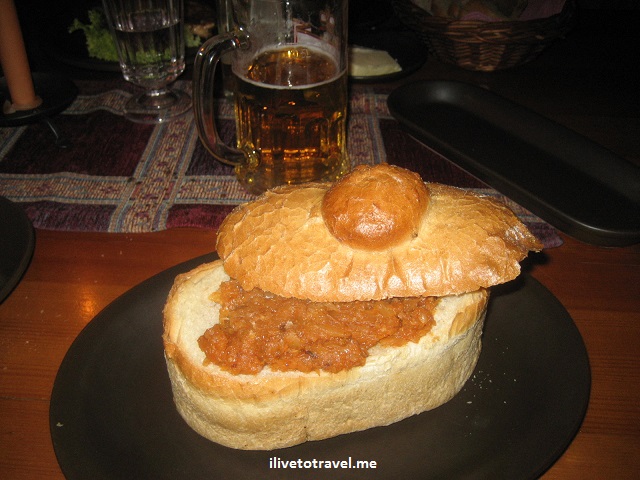
So what is the Polish food I experienced?  Well, lots of meat (especially pork), potatoes (fried or baked, of different shapes), little in terms of greens (unless you order a salad), bread (served with lard in the more traditional places I went to; yes, LARD but it had bacon to probably make it healthier :) ), etc..  A lot of the pork was fried which reminded me of my favorite Cuban dish but the pork knuckle was not fried (it was very tender!).  I also enjoyed pierogis (many options as far as filings), and pancakes stuffed with spinach and ricotta cheese.

img_80461

img_82891

March 6th, 2009 Posted by | Good Eats and Drinks | 4 comments

Language When Traveling Abroad

When traveling outside one’s country, language can be a barrier, a nuisance, or part of the adventure. As much as I can, I try to make it the latter. Case in point: the trip I just completed to Poland.

Though I was told many people I would deal with as a tourist in Poland would speak English, it seems to me this is more true of the younger generations only. Dealing with women in their 40s and up in the train station cashiers, for example, required a mix of my basic Polish phrases, train schedules I had already printed, and, at times, hand signals. (Glad to report that I did well enough with no mishaps, though that makes the blog entry less exciting…)

Besides learning the pleasantries, I focused on learning the numbers, and questions and words related to transportation (how much did the fare cost, what is the schedule, etc.) and food (gotta know what I ate so I can describe it later!). The most important phrases/words for me to learn were those related to transportation since we were going to be doing a lot of bus-ing and train-ing. Last thing I wanted was to be in a smaller town trying to get back and missing the last train because of a mis-understood time or ending up somewhere totally different… (hey, that is not too far-fetched: it happened to me flying from Boston to Atlanta in 1994 and that WAS supposed to be a language I was fluent in… but I digress).

I was able to mumble my way through canned phrases (or made-up phrases I assembled myself!)  from my Learn Polish podcast. Among the phrases that I used the most were:

  • How much is the fare?
  • I don’t understand.
  • How much does this cost?
  • One one-way ticket to Krakow for today
  • I would like today’s schedule for buses to Wadowice
  • And everyone’s favorite: Do you speak English?

It was neat, after a couple of days, to have the language in its written form begin to make sense. For example, I began seeing words I had learned used in signs in other contexts and was able to get the sense of the signs. (I am a geek, I know. Languages fascinate me.).  I also got to enjoy hearing the language and began to more rapidly recognize numbers thrown at me in response to a “how much does it cost?” question.

If I have to boil down language advice for travelers that I believe applies anywhere is learn the pleasantries, at minimum. Even if people in the country you visit speak your language as a second or third language, saying the hello, good mornings, please, thank you, etc. in their language goes a long way. Everyone likes to be acknowledged and I believe addressing someone in their language acknowledges them, no matter how poorly the words come out. While visiting remote villages in Tanzania, I was always asked to make a small speech as a visiting American from my organization (the first time that threw me off as no one had warned me and I am not good at speeches).  I had learned ahead of my trip basic Swahili; enough to say hi, I am glad to here, I am American, and I like your country (all true statements).  It was cool to see them smile when they realized I was actually trying to speak Swahili though the smile may have been half being amused at my poor attempt!  I felt it was a better connection than had I stayed remote and relying 100% on a translator.  If you can do more than the pleasantries, that is great.

A final tip is that making a short note you carry with you (electronically or on paper) with the phrases you most expect to use.  In my Poland trip, these would be the transportation-related ones since I was going to be self-reliant on arranging for that. That way, you avoid fumbling through a dictionary or to the back of a travel guide at key moments with a line forming behind you!

March 6th, 2009 Posted by | Travel Stories | no comments

Last Day in Krakow

Alright, vacation is almost over, I am on my last evening in Krakow prior to heading back home. Morning flight at 5:30 AM to Prague, then another to JFK, and then Atlanta. It will be hard but sitting down for a long time sounds good after all the walking I have done this week. I have eaten all sorts of delicious yet very fatty food (the whip cream here is REAL cream!) but I don’t feel my jeans are any tighter!

img_7951I need to write more about a few experiences from the trip but here I will recap some of the sights in Krakow itself.

The city is loaded with history. It used to be the capital and we visited the site of the royal palace, Wawel Castle (http://www.wawel.krakow.pl/en/), which sits atop the hill of the same name. Unfortunately, the royal residence was closed for a few weeks and re-opens on Monday. But we visited the crown treasure and armory museum in the basement of the palace and also toured the Cathedral (which is also in Wawel Hill) and the royal tombs underneath it. All very impressive (reading up a little Polish history before the trip paid off!).

We also got to see very different style churches and key sites in the life of Karol Wojtyla (John Paul II). He clearly is still a big figure in the city where he lived most of his life and served as priest, bishop, and cardinal.

We have eaten very well and will write more about that later. Highlight of the day was finding a bakery with cream cakes, like the one I ate in Wadowice. Mmmm… cream cakes…

Today has felt very cold due to high winds.  I learned from someone that it is the “halny”  (winds from the Tatra Mountains http://en.wikipedia.org/wiki/Halny).

I am guessing my next entry will be once I am home but have a few odds and ends to write about the trip. The trip, though short, has been well worth it!

March 5th, 2009 Posted by | Europe, Poland | no comments

Wadowice: Birth Place of a Pope

Among the key figures of the 20th century is the late Pope, John Paul II. He not only was a giant in the Catholic religion but his role in the fight in his country against Communism (and with consequences in the rest of Eastern Europe at that time) was pivotal to big change. We took a short trip to the town of his birth and childhood, Wadowice, to learn more about his early life and the town that saw him grow.

John Paul II statue in his hometown of Wadowice, Poland

As far as transport, mini-buses and regular buses depart Krakow, where I was visiting, with regularity. The former from a non-descript parking lot across from the Galeria Krakowska (a regular shopping mall) (the tourist info office pointed us to it). The latter from the bus station on the other side of the mall. There is also a Pope train but it seems not to be running or not in the day we were going, one of those details beyond my tourist Polish…

Going on regular bus has the added advantage that it will stop at the bus station of the town you want whereas a mini-bus requires you knowing what stop to get off on (which is hard if you have never been to the place). Unfortunately, we went over in a mini-bus… So once the time was close to get to Wadowice, I kept my eyes peeled on the approaching town and then just asked for Wadowice centrum to let the driver know where I needed him to stop (in a mini-bus you have to tell them to stop by walking to the front).

Once in town, things were pretty easy. It wasn’t as small a town as I expected but not big either. We immediately ran into the tourist info office where we oriented ourselves to the key sites to visit. Being that it was still early, we decided to first try one of the famous Wadowice cream cakes. The Pope apparently greatly enjoyed them as a kid and they came back in fashion either when he became a bishop, cardinal, or Pope. Wow, loaded with fat and calories but absolutely delicious [did I already say good eats??]. A touch of brandy nearly makes them heaven on earth!

Cream cake, the favorite of Pope John Paul II as a kid

First off, we visited the apartment where he was born and lived most of his childhood. It was moving for me to see the pictures of this kid who would come from this town to be one of the top figures of his time. Seeing the room where he was born with a picture of him as a baby was special. The apartment-come-museum is fairly small and well signed in English (not always true in places I’ve visited in the country). Much to my surprise, it was free though I’m finding out that is not uncommon for religious sites here (Jasna Gora in Czestochowa was also free). Oh, and we had to wear big old slippers over our shoes – since I was wearing my boots, they didn’t really fit so I had to slide over the floor instead of taking steps. I found myself still doing that shuffle at the museum next door (after taking the slippers off an hour or so before!).

Side of the building where Pope John Paul II was born in Wadowice, Poland

Side of the building where Pope John Paul II was born

Room where Pope John Paul II (Karol Wojtyla) was born in Wadowice, Poland

Room where Pope John Paul II (Karol Wojtyla) was born

We then visited the main church where he served as an altar boy and where he was baptized. It clearly has been renovated since he became Pope as it has acquired preeminence given the ties to him. (His childhood bedroom faces the church.) We got there during daily Mass (which is always a “short” Mass, 20-30 mins depending on the church) and it was fairly full but that could be because it was the holiday for the patron saint of Poland. The interior of the church was actually one of the prettiest I’ve yet seen in Poland.

Main church where Karol Wojtyla served as an altar boy in Wadowice, Poland

Main church where Karol Wojtyla served as an altar boy

We walked around town on this winter day and enjoyed seeing life going on as well as the side streets and buildings.

Around the main square in Wadowice, Poland

Around the main square

Side street in Wadowice, Poland

Side street

Around the main square in Wadowice, Poland

Around the main square in Wadowice

On the way back, we took a regular bus (about 60 cents more expensive). The buses, though, have more space and better windows to see the views along the route. The countryside in this part is more developed than I expected but we did pass some forests and saw beautiful rolling hills, some still with snow on the ground from a few days ago.

I don’t know if non-Catholics (or non-history-aficionados) would find Wadowice interesting enough to take the side trip but for me it was most definitely a special journey to make. It reminds me that any child has potential for greatness no matter the circumstances of their childhood.

March 4th, 2009 Posted by | Europe, Poland | 5 comments

A Somber Day in Auschwitz – Birkenau

Coming to Krakow is not a complete visit if one does not make the short trip to nearby Auschwitz and its counterpart, Birkenau, where more people died than in Auschwitz itself.    Clearly this entry will be more somber than my usual.

To get to Auschwitz, we took a mini bus from the bus station. We left at 830AM and got there around 10 AM. The day was gray and with a drizzle – apparently to set us up for the difficult visit ahead. Once there we decided to take a guided tour for a little over $10 which seems expensive but entrance to Auschwitz is free so we figured it would be worth it. (Otherwise, they have books/guides you can purchase and self-guide yourself.)

Guard tower in Auschwitz concentration camp in Poland, near Krakow

The group consisted of 6 of us and the guide. We passed under the well known “Arbeit Macht Frei” (work makes you free) sign at the entrance to the camps. An eerie feeling.

The buildings we visited in Auschwitz had been Polish army barracks before WW II. Many of these in Auschwitz I have been converted to museums. For example, a building will explain the origins of those who came to these camps. Another building depicts prisoner life. Another depicts the belongings gathered and what happened to them. Because these were army barracks before, the buildings are quite solid. If you think of an old building from around 1900 or 1910 at a U.S. university, you would know how these are designed and built.

Building in Auschwitz concentration camp in Poland, near Krakow


Some things were hard to see in the exhibits:

  • people’s belonging like hairbrushes, eyeglasses, suitcases (which had names and addresses on them); a strange feeling came over, thinking that someone used to, for example, brush their hair with that pink one laying on top of the pile or that one over there
  • women’s hair; their hair was shaved and sent to Germany as fibers or material for coats, blankets; some bags not yet shipped when the camp was liberated are on display
  • crutches and artificial wooden limbs
  • children’s clothing or artifacts were the hardest for me to see and process…

Though I understood we were basically in a very large cemetery or holy ground, walking between the barracks was surreal as I felt I was in a movie set. That may sound odd but given movies I have seen (Schindler’s List, Life is Beautiful, etc., whether actually filmed here or not) they were my only reference so far about concentration camps. But, of course, this was the real deal. In the gloomy weather we had, maybe my mind was shifting to “movie set” to protect me…

I tried picturing the guards and prisoners walking around and it wasn’t hard to envision the scene. Also quite hard to take was going into one of the gas chambers. It was an earlier one, too small for the mass scale the Nazis needed. It was used mainly for Soviet prisoners of war and Polish intelligentsia and activists imprisoned at the beginning for being dangerous. We also saw where St. Maximilian Kolbe died. He traded his life to save a man who had a family. For some reason, the Nazis allowed the switch. How many other acts of nobility may not have been caught for posterity…

We then went to Birkenau which the Nazis destroyed towards the end of the war and where the majority of Jews were exterminated in this set of camps. The main entrance building was shown in Schindler’s List.  The camp was built especially for large numbers. About 90,000 lived there at a time but hundreds of thousands died there. Living conditions were horrible and one can visualize them from reconstructed living quarters.

Entrance to Auschwitz concentration camp in Poland, near Krakow

The gas chambers there were of mass scale as were the crematoriums. You can see their ruins (they were not reconstructed) and you can see the field were ashes were then buried. It was a massive camp.

Gas chamber ruins in Birkenau concentration camp in Poland, near Krakow

Gas chamber ruins

One of the more poignant spaces in Birkenau was the train platform where people were separated into those going straight to their death vs. those who had some value to the camp as workers. One can only imagine first how those people would feel after a multi-day train trip packed in a wagon and then to get separated quickly from your loved ones. Very painful to imagine.

Train platform in Auschwitz-Birkenau concentration camp in Poland

So a very difficult place to visit but one that helps make sure we do not ever forget the cruelty that mankind is capable of when it loses its humanity.  Check out a short slideshow of my pix at http://www.youtube.com/watch?v=i7K5Hh41Qss .

May all those souls who died there rest in peace.  Their lives stolen and the survivors’ lives shattered and battered as this lamp bears witness…  Never again.

Train track lamp in Auschwitz concentration camp in Poland

March 4th, 2009 Posted by | Europe, Poland | 5 comments

Pilgrimage to Czestochowa

The main reason to go to Czestochowa is to see the spiritual heart of Poland, if you will.  The Black Madonna – a key religious item (supposedly painted/carved onto a table by St. Luke, the Evangelist) and an item also tied to Polish history – resides at the Jasna Gora monastery/fortress.  I was expecting to be visiting another important site, take a few pictures, and learn something.  But I learned something I was not expecting to learn as I did when I visited Auschwitz-Birkenau

A Monastery Fortress – Jasna Gora

The Jasna Gora monastery seemed daunting at first.  It sits atop a hill and surrounded my massive fortifications.

Jasna Gora monastery and complex in Czestochowa, Poland

However, a visit to the info office at the monastery quickly made it very accessible to us.  As quick background, back in the 17th century (or was it the 16th?), the monastery resisted the Swedish armies that had just conquered and ravaged most of Poland and I think may have been the only place not taken thereby ensuring the continuity of Poland at the time (someone with better history, please correct me or add to this info!).

To get to Czestochowa from Krakow, the best way was a 2hr+ train ride.  Upon arriving at the train station, we took a cab to the monastery on recommendation of a Krakovian who said there wasn’t much to see along the way. We were glad we did because of the timing of our arrival at the monastery.

The painting of the Black Madonna hangs in the altar of the chapel next to the Basilica.  The painting is not always exposed and the screening (covering up) and un-screening of it are key events which we got to witness almost by coincidence in the timing of our visit – pretty cool.

Chapel with the Black Madonna in Jasna Gora in Czestochowa, Poland

The chapel fills up with pilgrims or locals, people kneel during the un-/screening, and big trumpet (or horn) music plays for the important moment.  At the info office, we were informed that the next screening was 15 mins away – so our timing was great (this only happens twice per day).  An hour and a half later the un-screening would take place so we would be there to see it – this worked well because it was the right amount of time to see the 3 small museums in the monastery in between events.  The un-/screening was not as momentous for me though I’m aware how important it is religiously here and how it played a key part in Polish history.  I imagine if I were Pole, I would have experienced differently but seeing it and seeing the locals at those moments definitely gave me a view into Poland.

One nice surprise was the second story of the chapel (we accessed it via the Knights Hall).  The stations of the cross (plus 2 extra stations) were painted around 2000-01 by a painter named Duda Gracz. They are fairly graphic but basically place the stations of the cross with key personages or events (mostly from Poland).  For those familiar with the stations of the cross, one depicts Veronica helping Jesus. In this version, it is Mother Teresa.  In the one where Jesus walks past his mother, the Black Madonna is the figure shown.  The Holocaust is also represented very vividly.

The museums in the monastery are simple and small sized but the arsenal one was my favorite as it eventually displays photos and key items from the Solidarity movement in the 1980s. Very moving to see.  Part of it is built around one of the exterior corner walls of the fort so that was pretty neat.  Walking around the fort is really neat.

View of Czestochowa from Jasna Gora

Looking towards the main avenue from the fort

Jasna Gora building in Czestochowa, Poland

Jasna Gora building in Czestochowa, Poland

Out and about down the Main Thoroughfare of Al. NMP

Once done with Jasna Gora, we walked down the main thoroughfare (known as Al. NMP due to its long name) and stopped at a cafe for a snack.  The first cafe we tried only had desserts (no pastries) and was very smoky (while there are non smoking sections in some restaurants I ate at.  Those non-smoking sections were usually worse off than the smoking sections).  The second place, a few doors up, had the front door open so it was very pleasant inside and, besides desserts, had pastries.  The almond/apple tart I had was delicious.  That and a cafe au lait totaled a whopping $3.25. Nice.  The place was spotless, the restroom clean and the cafe had good ambiance.

We kept walking down Al. NMP until we saw a plaza with a very large cross and a status of Pope John Paul II in from of St. Zygmunt Church.

St. Zygmunt Church in Czestochowa, Poland

St. Zygmunt Church in Czestochowa, Poland

We arrived to the area near the train station, typical of many train stations around Europe.  With extra time in our hands, I had some time to snap a few shots along the way.

Stands near the Czestochowa, Poland train station

Stands near the train station

Train station at Czestochowa, Poland

Train station in Czestochowa, Poland

Czestochowa, while not seemingly as exciting as Krakow in the short duration of our visit, certainly helped me know Poland a little better and is a great destination for those wanting to see more of Poland – a place unencumbered by the importance of Warsaw or the fame of Krakow.

March 3rd, 2009 Posted by | Europe, Poland | 16 comments

Going under at the Wieliczka Salt Mines near Krakow

Among the many great things to see in Krakow, many are actually OUTSIDE of Krakow.  Wadowice and the Wieliczka Salt Mines are both great examples.

To get to the Wieliczka Salt Mines, a UNESCO world heritage site, one can take bus 304 from Krakow or a mini-bus (same prices, but less comfortable than the main bus and probably not as nice a view). Either costs 2,60 zl each way (less than $1). I always enjoy figuring out how to buy tickets; there always seems to be something new for me in a new country. Here, pretty straightforward: if you have coins, you can buy from the machine in the bus. Some bus stops have a machine that accept bank notes. Either way, don’t forget to stamp the ticket once in the bus!

The ride was pretty smooth and took about 20 mins. We got off the bus when we saw other tourists in the bus do the same but we didn’t know where to go. My thought was to follow them but unfortunately the two parties took an equal number of separate routes, placing us in a quandary. But with some confidence, we followed one of the parties and made it fine.  But we got to see some of the area around the mines as we made it there!

Wieliczka, Poland near Krakow

Wieliczka church, Poland (near Krakow)

Wieliczka in Poland, near Krakow

At the mines, there are English tours available with groups starting every hour or so. We hadn’t checked ahead with the information office in Krakow (always a good idea, especially with so many info offices in Krakow!) so we got lucky that the next English tour was like in 10 mins. Taking the tour in English cost extra but was worth it.

The tour starts with a climb down a staircase that was maybe 25 stories. You then meander through tunnels between chambers in the mine, each chamber with different decorations (mostly religious and most all made from salt too). Since the miners used to have daily Mass offered down there, a few of the chambers are chapels.  The most impressive chambers are at the bottom of the tourist route and well worth seeing.  One hardly feels “trapped” while there as it is well ventilated.  The salty air is actually quite good for you (which I undid later in the evening by going to a pub with all the smoking that goes on in such places – not by me).  People with respiratory ailments supposedly visit longer for therapeutic reasons.  The tour took about 2 hrs and the guide interjected the usual funny comments along the way.  At the end of the tour, well over 100m underground, there is even a cafeteria in one of the big chambers in the mine.

Wieliczka salt mine

Most of what you see here is made from salt!  (Credit:  http://www.wieliczka-saltmine.com/visiting/pilgrims-route)

Wieliczka salt mine

Most of what you see is made from salt here too! (Credit: http://www.wieliczka-saltmine.com/visiting/pilgrims-route)

To go back up, we didn’t have to climb back up but were packed tighter than sardines in a lift about 2.5ft deep by maybe 4ft wide. Good thing the person right in front of me had brushed his teeth and wore deodorant!

The salt mines get a thumbs up, especially because they are so accessible from Krakow and they are simply an experience!

March 3rd, 2009 Posted by | Europe, Poland | 9 comments

Switzerland: Lausanne and the Lavaux wine region

Guest post by friend and fellow traveler, Chris Sanders.

After a few tortuous days on the Tour de Mont Blanc (see my related post), my wife and I were looking for a place in which to relax and recover…and we wanted to stay in the region…it didn’t take me long to decide on the perfect place…”we’re going to Lausanne” I told Wendy.


Getting there and finding a hotel

Lausanne is nestled on the shore of Lake Geneva, about an hour by train from Geneva. The city is sort of like Nice in France – except its smaller, quieter, cleaner, more quaint, more sophisticated, and I could see myself living there…come to think of it, I guess its really nothing like Nice…except that both towns sort of slope downwards towards the water’s edge.

We didn’t book a hotel ahead of time - the prices were just too expensive online. Instead, upon arrival, we immediately found the Tourist Agency (adjacent to the station), where we booked a nice room at a clean little place called Hotel des Voyageurs http://www.voyageurs.ch/en/index.php. The hotel was more than adequate and it was situated off of a quiet and narrow street in the old part of the city – perfect actually. We were pleasantly surprised to find our room also had a balcony overlooking the small street – at night Wendy and I would have a few glasses of wine and watch people coming and going below us…

Out and about in Lausanne

The old part of Lausanne is great to explore on foot. There are several small cobble stone type streets to walk, and since the town is perched on a hillside, there are also plenty of ups and downs to navigate. We were treated to a large outdoor market one day we were there…the streets were so alive with locals strolling and shopping for fresh produce and antiques.

Another “must see” located in the old part of town is the city’s gothic Cathedral – Notre Dame. The church is located at one of the highest points in the city…as such, it is accessed by foot via a quite long and steep flight of stairs, some portions of which lie on the Camino de Santiago (see my related post). After an arduous 10 minute trek, we arrived to the top of the stairs.  Off to the left hand side was the large front door to the Cathedral…in the other direction was a landing area overlooking  impressive panoramic of the city – you could see all the way down to the lake!

Aside from the old part of town, another great aspect of Lausanne is the lake front, which was very nice indeed. A wide asphalt path runs parallel for miles and on good days, people walk about,   rollerblade, and just sit on benches. Out on the lake, sailboats and rented paddle boats lazily sweep across the water…against the backdrop of steeply rising mountains of the opposite bank – it really is the perfect place to relax.

As if it needed more, the lakefront also boasts the headquarters of the International  Olympic Committee and the Olympic Museum (http://www.olympic.org/uk/passion/museum/index_uk.asp). Wendy and I visited the museum and actually watched some of the Beijing games (which were going on at the time of our visit). Among the many treasures on display in the museum is a large Olympic torch collection – its definitely worth a visit.


A day trip to Lavaux

After recuperating in Lausanne for a few days, Wendy and I decided to explore the nearby wine region of Lavaux – a region knows for stunning landscapes of steeply sloped vineyards that extend all the way down to the lake.  It was easy to get to by train and there were several small villages to explore.  We took a train to Vevey, where we then boarded a smaller “wine train” that passed through several small villages.  We ended up in a small village called Cully, which was supposed to the an epi center of the region…unfortuntelyit was Monday and the place was empty and pretty much closed down. But all was not lost – we found a small cafe where we sampled a local white wine and asked the waiter what we might do to pass the time. His suggestion was a walk through the nearby vineyards, which we did over the course of about an hour – it was absolutely beautiful!! Wendy and I decided if we ever returned to the region, we would book into a countryside bed and breakfast so we could really take in the beauty of the region and have a full experience.

Incidentally, the Lavaux wine region was designated as a UNESCO World Heritage Site in 2007 http://whc.unesco.org/en/list/1243. We were not surprised…

If you’ve been to Lausanne or the Lavaux region, please share your experiences and  recommendations. We welcome your comments!

March 1st, 2009 Posted by | Europe, Switzerland | no comments

From Atlanta to Krakow – Planes, Train, Bus and Automobile

img_80142I am in Krakow!  This blog post (and the next few) will be written during a trip.  Nice change for me and maybe for the readers??  Just arrived in Krakow yesterday late afternoon local time.


A flight

Flying to Warsaw via Amsterdam with KLM went without a hitch aside from the possessed kid on the transatlantic leg. More than the screaming child, the screaming mother was the worse part. Where is flying Super Nanny when you need her?

Schiphol, as usual, a great airport to connect through. At Warsaw, much to our chagrin, passport control was closed (yep, I am a sucker for that passport stamp).  I guess they are not concerned with who is coming (just keep coming?).

A bus ride

The Warsaw airport was quite small and very easy. The information desk was very helpful and pointed us to take a bus to the Warsaw Central train station instead of taxi (bus nbr 175; bought the 2.8 zloty single pass at the ever-present Relay shop).  Outside of baggage claim, there was an ATM (why are these machines always tucked a way at the far end of the arrivals building in many European airports?) and money problem solved.

A train ride

In about 20 mins (a Saturday morning), we were at the station.  It is a maze of alleys and shops and not quite like the train stations I am used to in Paris, Madrid or London.  The ticket windows are not in one central area but there are numerous small kiosks called “Kasa” (cashier, I suppose) around. We walked past a couple before being comfortable that was where we needed to go.  The lady did not speak English but between a printout I had of the schedule and my phrases for asking about price, etc., the transaction was done!

Then to grab lunch where, again, the person didn’t speak English.  Between my broken Polish and hand signals, it was all good.  We decided we were too tired and splurged for a first class ticket on the train.  What sold us on the idea was how cheap it was: $40.  The ride was smooth and uneventful.  Two other folks shared our compartment and they didn’t say much until they left the train when they told us goodbye in English.

An automobile ride

Once in Krakow, though we weren’t far from the apartment, we were exhausted from lugging ourselves and our luggage around and chose to cab it.  It also saved us from figuring out directions at dusk, etc.

Our host’s friend met us and gave us great advice for local things.  He actually spoke almost perfect Spanish and pretty good English.  Impressive.

Next time, I will write about the food (so far) and the initial impressions of the town and the Salt Mines at Wielickza.

March 1st, 2009 Posted by | Europe, Poland | 9 comments